

Landcruiser 79 world trip: how we got Donkey ready
When we bought Donkey, we had no plans at all to drive him around the world. But how did we made the Landcruiser 79 world trip ready. We’ve been travelling regularly through Africa since 2007, and in 2016 we did some fairly simple maths. We were visiting Southern Africa two or three times a year, and hiring a car every time was getting expensive. Owning one worked out cheaper. That’s how we ended up buying our first Toyota Hilux in 2016. It seemed like a good solution at the time, until we increasingly realised that the car was particularly good at one thing: taking us to the garage.
After a few years, we’d had enough. We’d had so many mechanical problems that we sold the Hilux in 2021. Above all, we didn’t want to spend every holiday at a garage again. But the urge to travel never really went away. A few years later, we started getting itchy feet again, and that’s how Donkey came into our lives.
From Southern Africa to a world trip
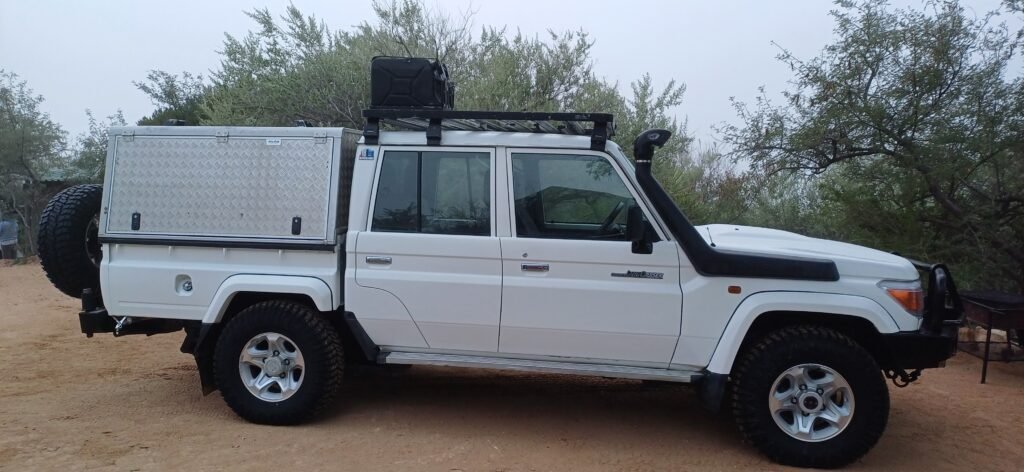
We bought Donkey from Bushlore in 2023. He’s a 2019 Toyota Land Cruiser 79 Series with a 4.2-litre 1HZ diesel engine. He had 150,000 kilometres on the clock, and we paid €34,000. Bushlore didn’t normally sell vehicles that were more than about three years old. With Donkey, the pandemic year made things slightly different. He’d barely been driven that year, which made this four-year-old vehicle worth considering.
The original plan was fairly simple. We mainly wanted to travel around Southern Africa. We might start in Windhoek, drive on from there, then leave the car somewhere like Lusaka and return later. A world trip? That wasn’t on our minds at all.
One thing that did matter to us from the start was reliability. Donkey needed to be a 4×4, relatively simple mechanically and dependable. And because we’d be driving through different countries, we wanted parts to be readily available. We deliberately chose the 4.2-litre diesel with the 1HZ engine. No complicated electronics, and an engine known for its simplicity.
Of course, there were downsides too. Fuel economy certainly wasn’t a strong point, and we knew the 1HZ wasn’t exactly a powerhouse. But we accepted that. Reliability mattered more to us.
Why a Land Cruiser rather than a Hilux?
Choosing a Land Cruiser was fairly straightforward. We wanted a Toyota, which left us looking at a Hilux or a Land Cruiser. A Hilux is a fantastic vehicle. It’s more comfortable, has more creature comforts and drives beautifully on tarmac. It handles sand well too.
But the way we tend to put it is this: a Hilux is a good road vehicle that can also go offroad. A Land Cruiser is a great offroad vehicle that you can also drive on the road. That difference mattered to us.
With a Land Cruiser, you give up some comfort. It has a huge turning circle, for example, and the leaf springs sit below the rear axle, costing you some clearance there. But for us, something more important made up for that: reliability. And, to be honest, a Land Cruiser 79 with a 4.2-litre 1HZ diesel was also a bit of a boyhood dream.
That combination was what appealed to us most: a tough, relatively simple vehicle with an engine without complicated electronics. In the end, that settled it.
Then the plan changed
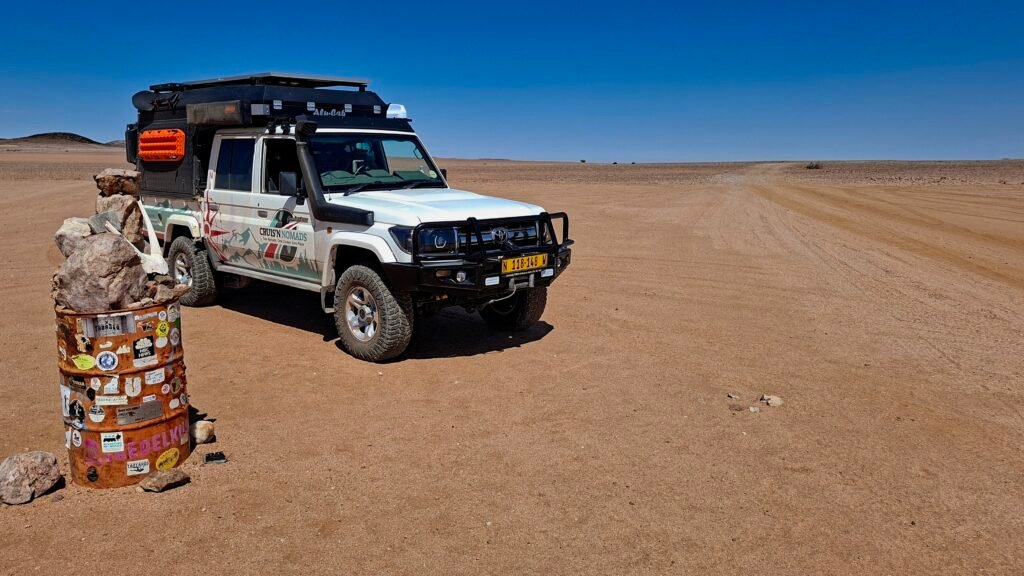
In 2025, we sold our house. Suddenly, the idea was no longer just to travel around Southern Africa, but to set off on a world trip. That changed what we needed from Donkey too.
A vehicle you use for a few weeks in Africa now and then is one thing. A vehicle you want to take across several continents for years, often days away from a decent garage, is another. Above all, we wanted a vehicle we could trust.
So we started talking to people with plenty of Land Cruiser experience. One of them was Stefan in Windhoek. He knows these vehicles inside out, including their weak points. Using advice like his, we asked ourselves: what really needs doing, and where do we simply not want to take a chance?
After our experience with the Hilux, we had some fairly clear views on that.
First, we worked out what needed doing mechanically
Once we’d decided that Donkey would be our vehicle for the world trip, we didn’t just start replacing parts at random. We spoke to several people who knew Land Cruisers well. Their advice helped us identify which components deserved attention and which risks we wanted to reduce as much as possible before leaving.
Donkey was already in good mechanical condition when we bought him. On the advice of Offroad4x4 in Windhoek, we replaced the original suspension with OME suspension straight after buying him. We then continued with the mechanical preparation.
The engine: there wasn’t all that much to do
In the end, we didn’t do a huge amount to the engine itself. First, we had a compression test done, and the results were good. That was reassuring.
We then had the injectors and fuel pump overhauled as a precaution. Not because Donkey was running badly or smoking. There was nothing wrong with him. But the work wasn’t too expensive, and the advice was to go ahead and do it. So we did.
We also had the valve clearances checked and adjusted. Two valves had too much clearance, and those were adjusted properly. We replaced the original exhaust manifold with a Genie Header too. The idea was to improve flow and possibly reduce fuel consumption a little.
Did it actually do that? No idea. We’ve changed so much on Donkey, and later added the entire camper setup, that there’s no way we can measure that properly.
Fuel: better an extra filter than an extra problem
Because we’d be driving Donkey through all sorts of countries, we wanted to give the fuel system some attention too. Diesel quality varies quite a bit from one country to another.
Donkey already had a standard fuel filter. We added another filter with a water separator. A bit excessive? Maybe. But when you’re somewhere you can’t simply buy a new fuel filter, it’s reassuring to know that your fuel system is as well protected as possible.
Water pump, timing belt and a major service
We replaced the water pump as a precaution. The timing belt was a bit less clear-cut. The paperwork said it had been replaced, but we wanted to be sure. So we had it done again.
While we were at it, we also had a major service done. Fresh engine oil, coolant, gearbox oil and differential oil. At least that gave us a clear starting point.
The clutch: straight to a heavy-duty version
Donkey’s clutch still seemed fine when we bought him. Even so, we were advised to replace it with a heavy-duty version. We hesitated for a while, because, well… if something still works, why replace it?
In the end, we went ahead. And looking back, we’re glad we did. The clutch held up really well throughout our travels in Africa.
We deliberately left the gearbox alone
This is where it gets interesting. We knew the H151F gearbox wasn’t the strongest part of this Land Cruiser. We even considered having it upgraded as a precaution, with a stronger fifth gear and shaft.
But that would have cost quite a lot. And you have to draw the line somewhere. So we decided against it. We changed the oil, and otherwise we’re using it as it is.
So far, that’s been fine. Will we still feel that way in another 100,000 kilometres? We’ll find out.
Brakes and wheel bearings
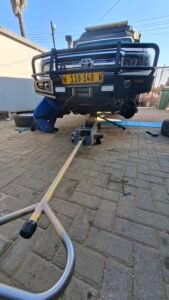
Before leaving, we gave the brakes a thorough overhaul. We replaced the front discs and pads, and the rear drums and brake shoes. We also replaced all four wheel bearings as a precaution.
These might not be the parts that get you excited when you’re building an overland vehicle. But honestly, they’re exactly the things you don’t want to deal with on the road. A nice canopy is great. A good fridge is great. A failed wheel bearing somewhere in the middle of Africa? Rather less enjoyable.
The suspension changed quite a bit
Soon after buying Donkey, we replaced the original suspension with OME suspension on the advice of Offroad4x4 in Windhoek. We’re still really happy with it. Donkey drives beautifully with this setup.
Fitting the Alu-Cab canopy camper added quite a lot of weight, of course. So we later added an extra leaf to the rear springs. After our travels through East Africa, we noticed that Donkey was starting to sway more at the rear. We then added a rear sway bar.
That’s one of the good things about travelling with your own vehicle: you get to know it better as you go and can adapt it to the conditions you actually encounter.

Starter motor, alternator and V-belt
We had the starter motor overhauled as a precaution, and the alternator too. Again, neither was causing problems at the time. It was mainly about reducing the risk of trouble later.
We replaced the V-belt and brought a spare as well.
The exhaust needed changing anyway
The original exhaust system was still fine. But when we had our dual fuel tank setup fitted underneath the vehicle, the exhaust needed modifying. So Donkey got a free-flow exhaust.
Along with that, we replaced the exhaust manifold with the Genie Header. We also had the EGR blanked off to reduce contamination in the exhaust system.
And then there was Donkey’s underside
Donkey had always been based in Namibia. That’s good for a vehicle, because the low humidity means rust is rarely much of a problem. But his underside was essentially bare.
Because we planned to spend years driving in all sorts of conditions, we had the underside treated with a corrosion-protection coating as a precaution. Another investment you barely see. But that pretty much sums up this whole preparation.
Which spare parts do we carry?
Before leaving, we put together a huge list of spare parts. When we showed it to a specialist in Cape Town, he started laughing a little. Apparently, we’d got slightly carried away.
In the end, we cut the list down considerably. We now mainly carry parts that make sense for routine maintenance or that we think could be useful on the road.
Our current kit includes:
- an oil filter;
- a fuel filter;
- V-belts;
- one wheel bearing;
- a set of coolant hoses;
- bushes for the rear leaf springs.
Quite a bit less than our original list, then.
What did it all cost?
Honestly? Quite a lot.
Our provisional calculation comes to around €7,000 for the mechanical preparation. That excludes some costs that came up later during the trip. The radiator we replaced after East Africa, for example, cost around €1,000.
We’d like to give you a much clearer breakdown of the full cost. Not just the total, but each individual item: the injectors, fuel pump, clutch, suspension, brakes and so on.
Want to know exactly what this kind of preparation costs?
We’ve put all the mechanical work on Donkey into one overview, including the cost of each component and modification.
Was all that preventive maintenance really necessary?
That’s a question you can never fully answer. If you replace something as a precaution and it never breaks afterwards, you don’t know whether you actually prevented a problem. Perhaps the old part would have lasted another 100,000 kilometres.
But for us, there was something else behind it too. Above all, we didn’t want to be on the road again in a vehicle that left us wondering when the next problem would come.
We often felt that way with the Hilux. Every few weeks, we’d find ourselves at another garage. During one four-month trip, we even had to have the engine overhauled. We have good memories of that period too, but we really wanted things to be different on our world trip.
Eight months in Africa have taught us more
We’ve now spent around eight months driving through Africa. And the good thing is that, mechanically, Donkey hasn’t let us down.
We’ve had no mechanical problems. Just routine maintenance and wear and tear. Looking back, we feel we can say the preparation was worth the investment for us.
Maybe we did too much. That’s quite possible. But it gives us peace of mind. And perhaps that’s the most important part of all this preparation.
A dependable vehicle matters more than a good-looking one
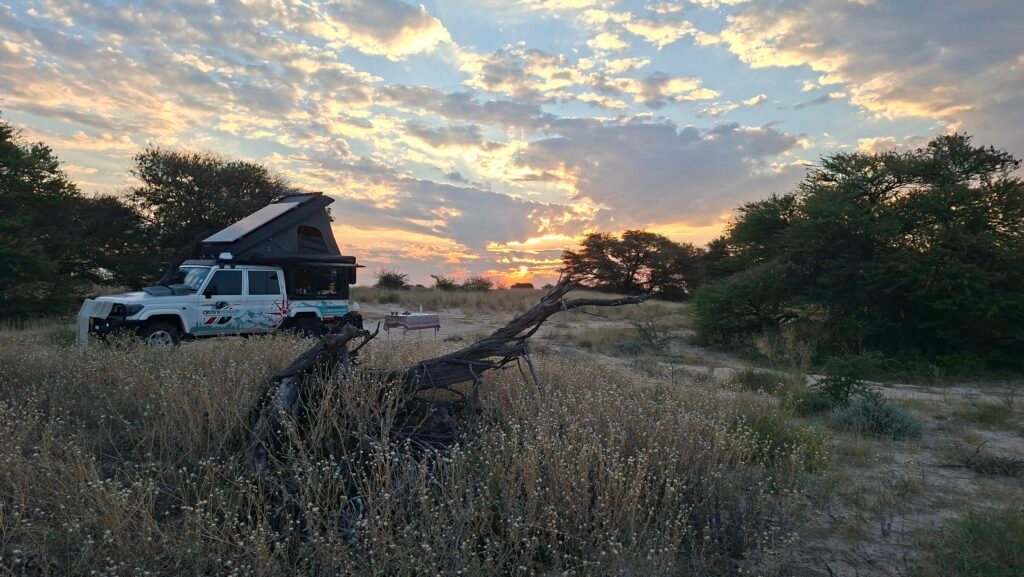
We often see people putting a huge amount of attention into the living space when they build an overland vehicle. A nice canopy, a good kitchen, a fridge, solar panels, a comfortable interior… And don’t get me wrong: all of that is great.
But personally, I’d give the mechanical side plenty of attention first. When you’re three or four days from the nearest garage, you’d much rather have a vehicle that makes you think, “We’ll be fine.”
Rather than a beautiful camper that makes you think, “Oh dear… I hope it holds up.”
We often had that uncertain feeling with the Hilux. With Donkey, we haven’t really had it at all.
So if you ask us what matters most when preparing an overland vehicle, our answer is simple: talk to people who really know your vehicle.
Get advice on the weak points of your specific model, and spend your money there. You might not see any difference afterwards. But you’ll feel it every time you’re driving somewhere far from civilisation.
For us, that confidence may well be the best thing we’ve built into Donkey.
FAQ
What mechanical work did you do on Donkey before the world trip?
Among other things, we had the injectors, fuel pump, starter motor and alternator overhauled as a precaution. We replaced the wheel bearings and brakes, dealt with the water pump and timing belt, changed all the main fluids and modified several suspension and exhaust components.
How much did it cost to get Donkey mechanically ready?
Our provisional calculation comes to around €7,000. We’re still working on the exact cost breakdown for each item.
Which parts of the mechanical preparation proved worthwhile on the road?
For us, the preparation as a whole. After around eight months travelling through Africa, we’ve had no mechanical problems with Donkey beyond routine maintenance and wear and tear.
What would you do differently with hindsight?
We’d probably do slightly less preventive maintenance. But overall, we’d make much the same choices.
Is a Land Cruiser 79 suitable for a long overland trip?
In our experience, absolutely. The combination of simplicity, reliability and offroad capability makes it a very good fit for us. You do give up some comfort compared with a Hilux, for example.
Which components would you definitely have checked before a long trip?
On our 1HZ, we’d certainly have the injectors, alternator and starter motor checked. We’d also have the gearbox assessed properly.
Conclusion
Donkey was never originally meant to be our vehicle for a world trip. We bought him to travel around Southern Africa and leave him in storage between trips. Only later did the plan change, and suddenly the same vehicle needed to be ready for several years of travelling around the world.
That’s why we invested heavily in the mechanical preparation. Looking back, we don’t know which problems we actually prevented. What we do know is that Donkey performed really well mechanically during our first eight months in Africa.
For us, that’s the clearest reassurance that we made the right choice.