
Car shipping from Cape Town to Montevideo: our experience
Shipping our car from Cape Town to Montevideo wasn’t the original plan. We were going to travel through East Africa with Donkey, our Toyota Land Cruiser 79 Series, then drive back to Europe via West Africa. After that, we’d see.
But at Lake Kivu in Rwanda, another idea came along. After our previous trips through Africa and almost another three months on the road, we were perhaps getting a little tired of travelling in Africa. In an overlanding WhatsApp group, a Dutch couple were looking for someone to share a container from Cape Town to Montevideo in Uruguay.
We looked at each other and soon started smiling. South America. That became the plan.
On 13 October 2026, we collected Donkey from the port of Montevideo. Here we explain how we arranged the shared container, prepared the car and tracked the shipment. We also share our costs and what happened when we collected Donkey and cleared customs.
This article covers our shipment in August–October 2026. The prices, arrangements and instructions described here applied to our shipment. Check the current terms with your agent and insurer before arranging your own.
| Our shipment | Details |
|---|---|
| Route | Cape Town, South Africa → Montevideo, Uruguay |
| Vehicle | Donkey, Toyota Land Cruiser 79 Series |
| Shipping method | Shared high cube container with a German couple |
| Arrangements in Cape Town | Duncan from African Overlanders |
| Agent in Montevideo | Eduardo and Guillermo from Kessler |
| Departure, according to the information we received | 13 August 2026 |
| From departure to collection | 13 August–13 October 2026: 61 days |
| Shipping and handling for Donkey | USD 4,500 |
| Transport insurance | €422.50 |
| Certificado de llegada | Equivalent to €8.24 |
| Collection | 13 October 2026; the port process took around 4.5 hours |
Why we ended up shipping with a different couple
The idea was to ship with the Dutch couple. Raimundo was due to do some work in the Netherlands in September, so we could stay there while Donkey was being shipped.
But that work fell through. We weren’t sure what we’d do during the time without Donkey, so we told the couple we wouldn’t be shipping for the time being.
Still, South America stayed on our minds. Eventually, we decided to spend three weeks in the Netherlands visiting family and friends, followed by four weeks of Spanish lessons in Guatemala. That would fill most of the roughly two months Donkey would be in transit.
By then, our dates no longer matched those of the Dutch couple. We posted our own message in an overlanding WhatsApp group and got in touch with a German couple who also wanted to ship in August. We’d found our container partners.
Why we chose African Overlanders
During our travels, we’d heard about Duncan from plenty of other overlanders. Often, they didn’t even mention the company name, African Overlanders. They just talked about Duncan and spoke highly of him.
We contacted other companies too. Some didn’t reply to our emails or get back to us with answers. That made comparing options quite difficult. Duncan did reply, and that, together with other travellers’ experiences, was what decided it for us.
We found our container partners ourselves. Duncan arranged the handling in Cape Town and found the receiving agent in Montevideo: Eduardo.
We agreed on a price. We didn’t receive a formal contract. Duncan explained that he worked on a gentleman’s agreement. That was how we arranged our shipment.
Preparing Donkey for shipping
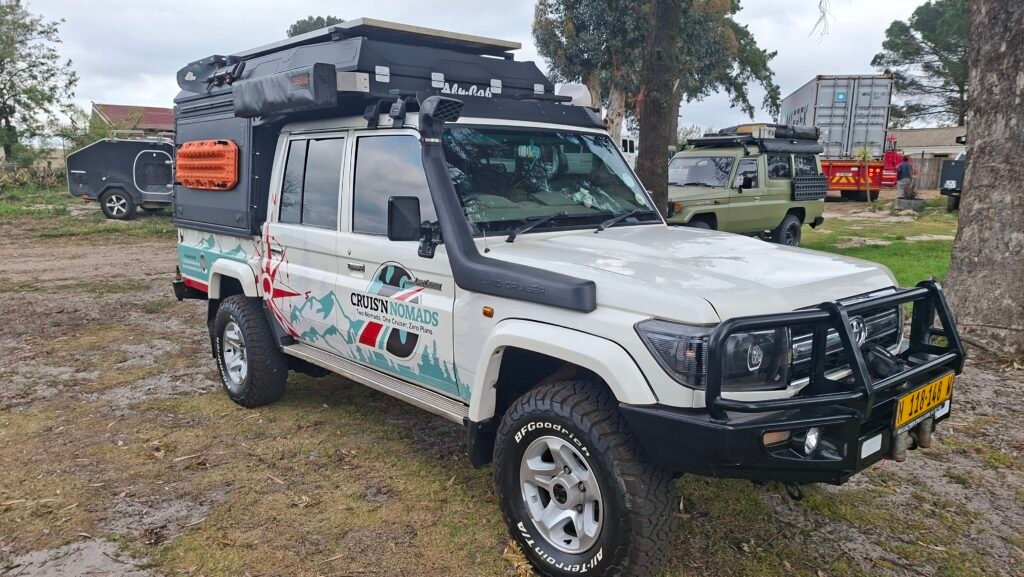
The instructions we received were fairly simple: keep as little diesel as possible in the tanks and disconnect the lithium leisure battery. Both batteries could stay in the car. We also disconnected the starter battery.
We emptied the water tank ourselves. We didn’t have a gas cylinder, so we can’t comment on shipping one from our own experience.
Into the container clean, dry and packed away
We gave Donkey a thorough clean and made sure he went into the container dry. We cleaned the fridge too and left its door slightly open. A window in Donkey also stayed open during transport. Loose items were in bags, packed away in the cupboards. We secured everything and placed moisture absorbers in several spots to help prevent mould.
Most of our belongings stayed in the car, including electronics and valuables. We were working on the assumption that the container would stay closed. That was our own choice. When we collected Donkey, everything looked good.
We only took what we’d need during the two months without him: clothes, a camera, a small video camera and other things for our stay. At Duncan’s request, the car keys stayed in the ignition.
Loading the shared container in Cape Town
We needed to be at Duncan’s campsite three to four days before loading. It wasn’t quite clear when the container would arrive. Tuesday or Wednesday: that was still to be confirmed. Arriving a few days early meant we’d be there whenever loading could begin.
When the time came, seven containers were ready, including ours. Our container stayed on the truck and was positioned in front of a loading ramp. That allowed us to drive Donkey inside.
We wanted to be there for the loading. It wasn’t compulsory, but we liked being able to see our car go into the container and watch it being secured.
Did Donkey fit in the container?
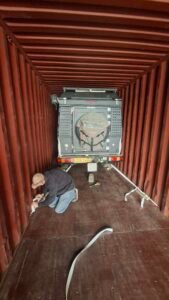
Yes. Donkey is 2.48 metres tall and fitted inside the high cube container we’d chosen. We didn’t need to remove anything or make any changes to the car.
Raimundo drove Donkey in himself. Duncan and his crew then strapped him down. Wooden blocks were nailed in place in front of and behind the tyres. Donkey was left with the handbrake on, in low range and first gear. The starter battery terminals were disconnected too.
We took our own photos of the car inside the container. Duncan emailed us the shipping document, referred to as the shipping bill in our correspondence.
Getting our carnet de passage stamped
We had a carnet de passage for our travels through Africa. We handed it to Duncan, who arranged for customs to stamp it. We then got the carnet back.
The process can also be handled using a TIP, a temporary import permit. Check with your agent what needs to be done for the document used to import your vehicle.
We didn’t need the carnet for our onward travels through South America. We sent it back to the issuing organisation and received our deposit back. In Uruguay, we received a TIP for Donkey when we collected him.
Tracking the shipment with Maersk and MarineTraffic
According to the information we received, Donkey departed on 13 August 2026. The container first went to Bremerhaven, where it was unloaded from the first ship and put onto another two days later for the onward journey towards Montevideo.
We used two websites to track the shipment:
- Maersk container tracking: using the container number, we checked the latest recorded container movements. That let us see that the transfer in Bremerhaven had gone smoothly. We also checked the sailing schedule.
- MarineTraffic: using the ship’s name, we followed the position of the vessel carrying our container.
During the shipment, the scheduled arrival moved back by two days. We didn’t think that was much on a journey of roughly two months. Unfortunately, we’d also heard from other travellers about longer delays.
We got Donkey back on 13 October 2026. There were 61 days between departure on 13 August and collection. That’s the full period up to collection, including the handling in Montevideo.
What transport insurance did we have?
We took out all-risk transport insurance for the shipment. The premium was 0.5% of the insured amount, which consisted of the value of the car plus the freight costs. Our premium came to €422.50, with an excess of €500.
Existing damage and defects were excluded. Third-party liability while driving the vehicle under its own power was also excluded from this transport insurance. Those were the terms we received for our shipment.
The first steps with the agent in Montevideo
In Montevideo, we were helped by Eduardo and his son Guillermo from Kessler. Kessler is a customs broker that handles shipped vehicles for travellers, among other services. The company coordinates with the shipping line, the port and the companies loading or unloading the containers, and takes care of the customs formalities.
Our first visit to the office went smoothly. Guillermo spoke good English. He checked our documents and made copies of:
- the vehicle documents;
- the driver’s passport;
- our Mercosur third-party liability insurance.
We’d applied for that Mercosur insurance through a company in Argentina while Donkey was being shipped.
We also needed to provide a Certificado de llegada. The agent explained that he’d contact us once the container had been released. We’d then go to the port to collect Donkey.
Getting the Certificado de llegada
We got our Certificado de llegada from the Dirección Nacional de Migración in Montevideo, close to the agent’s office.
As we entered, there was a staff member seated on the left, easy to spot. We explained that we’d come for the Certificado de llegada and handed over the vehicle owner’s passport. Then we sat down while the document was prepared.
They asked whether we were importing a car and whether we were tourists. After about ten minutes, the certificate was ready. It cost us the equivalent of €8.24.
The staff spoke English. Still, we tried a bit of Spanish with what we’d just learned in Guatemala. That worked too.
Collecting Donkey from the port of Montevideo
On 12 October, we received a message from Guillermo at 2 pm. We were asked to be at the office at 1 pm the following day. We’d discuss the final steps there, then go to the port together to collect Donkey.
Paying cash at the office
On 13 October, we arrived at Kessler at 1 pm. First, we had to pay USD 1,017 in cash for our share of the handling in Montevideo. This amount included the agent’s fees and port charges, among other costs.
Because we shared the container, these costs were shared too. The charge for the whole container was USD 2,034. Our payment of USD 1,017 was already included in the total shipping price of USD 4,500.
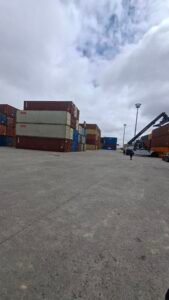
After paying, we walked to the port with Guillermo and around ten people. Five containers were opened that afternoon, containing six cars in total.
Passport checks at the port
On arrival, we had to show our passports. Only the people named as the owners on the vehicle documents could go with Guillermo to the containers. Everyone else waited on the port grounds.
We walked to the unloading area, where the five containers were ready. They were opened one by one, and the owners could then drive their cars out. Our container was last.
The port workers released Donkey. They removed the straps and the wooden blocks in front of and behind the tyres, then reconnected the starter battery. After that, Raimundo could drive him out of the container.
Why collection took around 4.5 hours
According to Guillermo, collection normally takes around two hours. For us, the whole process took about 4.5 hours. One of the other cars couldn’t easily be driven out of its container. It was so wide that nobody could get inside to drive it out.
Eventually, they managed to get that car out using forklifts. That accounted for a substantial part of the wait. Our experience of 4.5 hours shouldn’t be taken as the standard collection time.
Receiving the TIP at customs
Once all the cars were out of the containers, we went to a customs office with Guillermo’s help. We showed our passport and vehicle documents and received our TIP, the temporary import permit for Donkey.
That completed the process, and we were free to leave. We parked Donkey inside the port gates that evening and went back to our Airbnb.
What condition was Donkey in?
Donkey was mould-free and everything looked good. The moisture absorbers had collected quite a lot of water, both in the cab and in the camper body.
The car had gone into the container clean and dry, the fridge door was slightly open and a window had been left open. Together with the moisture absorbers, that preparation seems to have worked well for us. We can’t say which measure made the difference.
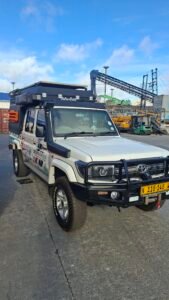
How much did shipping our car from Cape Town to Montevideo cost?
Our shipment cost a total of USD 4,500 plus €430.74 for the transport insurance and the Certificado de llegada. The USD 1,017 payment to Kessler in Montevideo was already part of that USD 4,500.
| Cost | Amount for Donkey |
|---|---|
| Shipping and handling, including our share in Montevideo | USD 4,500 |
| All-risk transport insurance | €422.50 |
| Certificado de llegada | €8.24 |
| Total cost | USD 4,500 + €430.74 |
The costs in Montevideo came to USD 2,034 for the whole shared container, and we paid half. That amount should therefore not be added to the total again.
We’ve kept dollars and euros separate so the figures match the currencies in which we’ve listed the costs.
Would you like a detailed breakdown of our shipping costs? Email us at info@cruisnnomads.com. We’re happy to share the individual items so you can see how our total was made up.
Our experience of the shipment
For us, the arrangements were straightforward. We found our container partners, Duncan handled things in Cape Town, and Eduardo and Guillermo from Kessler helped us in Montevideo with the documents, the port and customs.
Collection took longer because of a problem with another car. Once Donkey had been released from his straps and blocks, he could be driven straight out. He was mould-free and everything looked good.
From a WhatsApp message at Lake Kivu to our own car in Uruguay: two months after leaving Cape Town, we had Donkey back.
Want to know more about us and how we travel? Read our story.
Frequently asked questions about our car shipment from Cape Town to Montevideo
How much did it cost to ship our car from Cape Town to Montevideo?
We paid USD 4,500 for shipping and handling, including our share of the port and agent fees in Montevideo. With €422.50 for transport insurance and €8.24 for the Certificado de llegada, the total came to USD 4,500 plus €430.74. You can request our detailed cost breakdown by emailing info@cruisnnomads.com.
How long did shipping from Cape Town to Montevideo take?
There were 61 days between departure and collection: from 13 August to 13 October 2026. That includes the transfer in Bremerhaven and the handling in Montevideo. The expected arrival date moved back by two days during the shipment.
Could we share a container with another overlander?
Yes, we shared a high cube container with a German couple shipping at the same time. Duncan from African Overlanders arranged the shipment and loading in Cape Town. We split the shared handling costs in Montevideo equally.
Where and how was our car loaded in Cape Town?
Donkey was loaded at the African Overlanders campsite. A truck arrived with the container, which stayed on the truck during loading. Raimundo drove Donkey up a ramp and into the container. Duncan and his team secured him with straps and wooden blocks. Driving in and securing the car took around 15 minutes in total.
Did our Land Cruiser fit in a high cube container?
Yes, Donkey is 2.48 metres tall and fitted inside our high cube container without any modifications. We didn’t need to remove anything. Raimundo drove him in using the loading ramp.
How did we have to prepare Donkey for shipping?
The fuel tanks had to be almost empty, and both the starter battery and the lithium leisure battery had to be disconnected. Both batteries could stay in the car. We also emptied the water tank, cleaned and dried Donkey, and made sure all our belongings were packed away and secured.
Which documents did we need in Cape Town?
We handed our carnet de passage to Duncan. He arranged for customs to stamp it, and we then received it back. The shipping document, referred to as the shipping bill in our correspondence, was emailed to us.
Did we need a carnet de passage?
We already had a carnet for our travels through Africa and had it processed when Donkey left. A TIP was another option, but we didn’t use one for this. We didn’t need the carnet for our onward travels through South America, so we returned it and received our deposit back.
Which documents did we need to collect Donkey in Montevideo?
Kessler checked our vehicle documents, the driver’s passport and our Mercosur third-party liability insurance. We also provided a Certificado de llegada. During the final customs formalities, we received the TIP, Donkey’s temporary import permit for Uruguay.
How long did collection at the port of Montevideo take?
According to Guillermo, collection normally takes around two hours. Our whole process took about 4.5 hours because another vehicle was difficult to remove from its container. The port workers removed Donkey’s securing straps and wooden blocks and reconnected the starter battery. After driving him out, we went to customs with Guillermo to receive our TIP.
Did we have to pay the Montevideo fees in cash?
Yes, we paid USD 1,017 in cash at Kessler’s office before going to the port. This amount was part of the total USD 4,500 shipping price, so it wasn’t an additional charge.
Did we take out transport insurance?
Yes, we took out separate all-risk transport insurance. The premium was 0.5% of the car’s value plus the freight costs, which came to €422.50. The excess was €500. Existing damage, defects and third-party liability while driving the vehicle under its own power were excluded.
Did our belongings stay in the car during shipping?
Yes, most of our belongings stayed in Donkey, including electronics and valuables. We only took what we needed during the two months without the car. Everything inside Donkey was packed away and secured. When we collected him, everything looked good.
How did we try to prevent mould during container transport?
We loaded Donkey clean and dry, left the fridge door slightly open and a window open, and placed moisture absorbers in the cab and camper body. He was mould-free when we collected him. The absorbers had collected quite a lot of water; we can’t say which measure made the difference.
How did we find someone to share a container with?
We posted a message in an overlanding WhatsApp group and got in touch with a German couple who also wanted to ship in August. Duncan from African Overlanders can also look for a container partner for you, so you don’t have to arrange this yourself.
Could we track the container during the journey?
Yes. Using the container number, we checked the recorded container movements and sailing schedule with Maersk. That showed us that the transfer in Bremerhaven had gone smoothly. On MarineTraffic, we used the ship’s name to follow the vessel carrying our container.
Why did we choose a container rather than RoRo?
We contacted several shipping companies. According to the information we received for our shipment in 2026, there were no RoRo services from South Africa to South America, although services operated in the opposite direction. RoRo therefore wasn’t an option for our route. We shipped Donkey in a shared container.
Would we ship with African Overlanders and Kessler again?
Our experience with both companies was positive. Duncan handled things in Cape Town and arranged for customs to stamp our carnet. Eduardo and Guillermo from Kessler guided us through the process in Montevideo. Donkey arrived mould-free and everything looked good: good reasons for us to choose the same combination again.