![logo[26]](https://cruisnnomads.com/wp-content/uploads/2026/02/logo26-120x79.png)
![logo[26]](https://cruisnnomads.com/wp-content/uploads/2026/02/logo26-768x507.png "logo[26]")
Overlanding Kenya: From the Uganda Border to Maasai Land
We arrive at a beautiful complex that turns out to be the border crossing. The Ugandan immigration officer asks how our time in Uganda was, and all we can say is that we spent three wonderful weeks there.
The same complex also houses Kenyan immigration and customs. We brace ourselves for a strict crossing full of bribery attempts. To our surprise, none of that happens everyone is friendly and helpful again. Within an hour we’re out of Uganda and into Kenya. We’ve never had a more relaxed border crossing a great start to our overlanding Kenya chapter.
From Kitale to the Viewpoint: Back to Luxury
At the next town, Kitale, we withdraw cash and head to a shopping mall with a huge supermarket quite the adjustment. Such luxury all of a sudden. At the entrance, vendors sell boerewors rolls. We read the sign twice to make sure it really says boerewors, and it does. Naturally, we can’t resist.
We camp on the edge of town in someone’s garden, surrounded by trees and, as a result, plenty of birds including the same noisy ones we got to know in Cape Town. There’s even a laundry service, which we happily use. We decide to stay two nights. The odd shower rolls through, but the sun is quick to return.
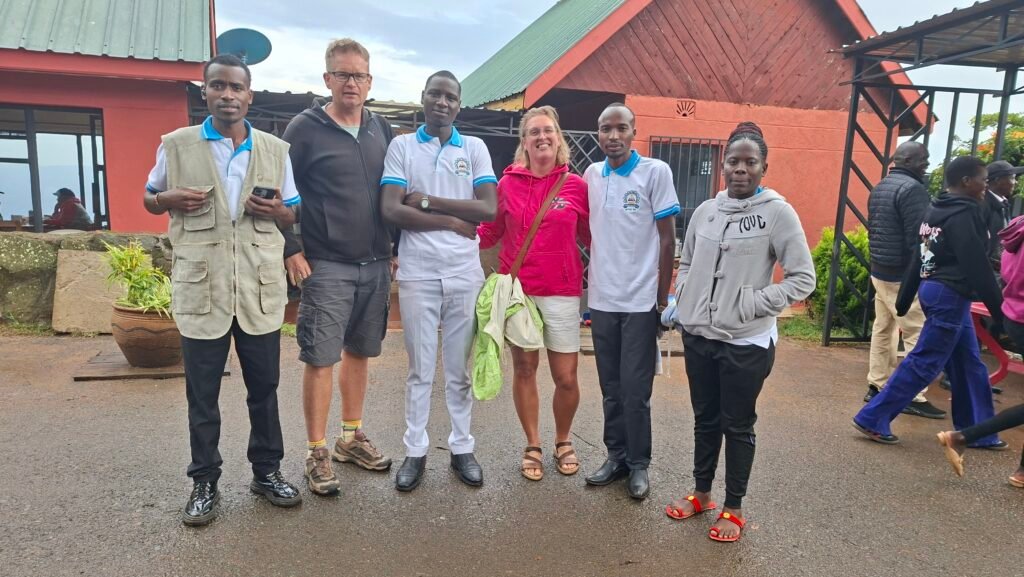
We set off again with a fully stocked Donkey. Raimundo has found a beautiful route to drive. Along the way we pass a viewpoint and stop, partly because it’s pouring rain. Over a cup of tea we notice the menu prices are remarkably low, even for a spot this touristy a good sign for our daily budget. 😀 Once the rain clears, we head outside to enjoy the view, but before we get there a group of people stops us for photos. By the end we’ve made a whole new set of friends. 😀 As we’re taking in the view, we’re asked again if we’d mind more photos. Of course not.
A River, a Stranded Car, and a Dented Canopy
Along the way we buy fruit and tomatoes from roadside stalls. We find a campsite and stay two nights again, meeting an Austrian couple also traveling through Africa. We swap numbers so we can keep each other updated on the safety situation around Lake Turkana.
We continue on a scenic route, eating local food along the way pilau for just a couple of euros, and it’s delicious. We’re heading to a campsite by a lake with a hot spring. Driving on a gravel road, it starts pouring rain. We have to cross a river, and a few locals wade ahead of us to show how deep it is. We make it through easily. A little further on we come across a stranded car, half in a ditch, and stop to help pull it out. Unfortunately, the rope isn’t properly secured to their vehicle, and it snaps loose the hook flies straight into our canopy. The result: a solid dent and some cracks. Lesson learned: next time, double-check that everything is properly attached on the other vehicle too. In the end, we manage to pull them out of the ditch.
We continue on to the campsite. Suddenly there’s a gate, and someone demands payment, claiming we’re entering the national park. We explain we’re not going to the park but to the campsite 650 meters further. He insists we have to pay. Luckily his colleague steps in, and we’re allowed through without paying. The guys at the campsite do their best to find a mechanic nearby, but no luck this time.
Fixing the Car in Nakuru: Servicing Donkey
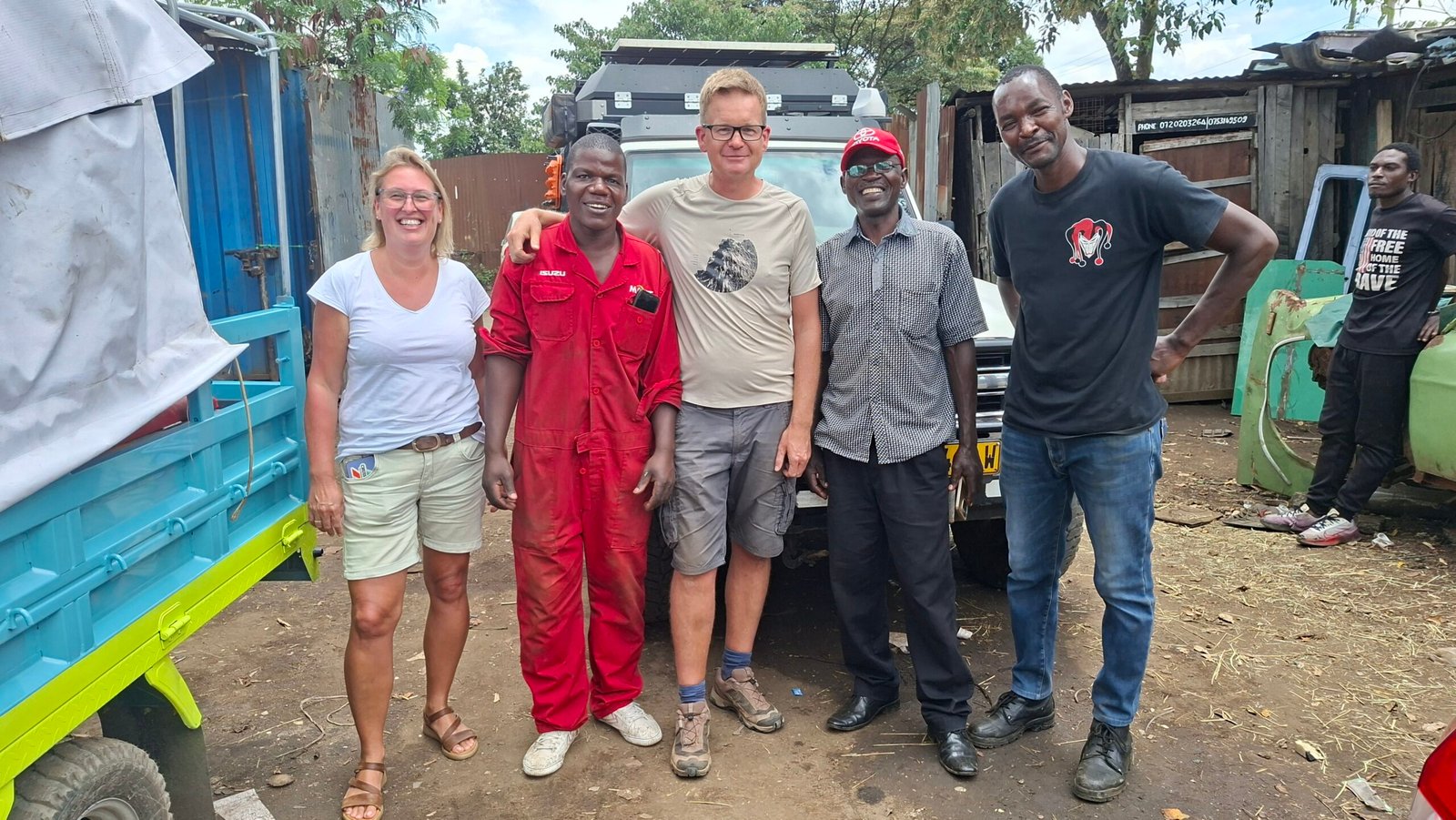
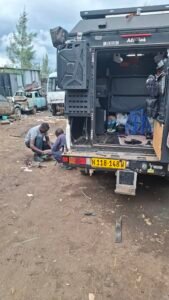
The next morning we drive on to Nakuru, where we can get Donkey repaired and give him a full service at the same time oil change, fuel filter replacement, and more. Raimundo pitches in wherever he can, picking up pointers from Odis, the mechanic, along the way. Some parts need to be picked up too, so Raimundo hops on the back of a boda boda with Odis to go fetch them. Once everything’s done, Raimundo gives the guys a “Donkey tour,” showing them the inside of the truck the kitchen is the highlight for everyone. Two great days at the garage: we swap numbers at the end and, of course, take a group photo before we go.
Camping at Lake Naivasha: Hippos, Monkeys, and Homemade Rolex
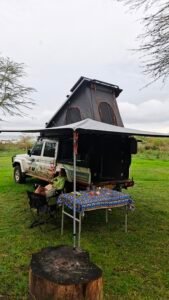
We drive on to Lake Naivasha, picking up groceries along the way this time including mince and chicken for the freezer, the first time we’ve used it. We camp at Lake Naivasha, where hippos wander past, fish eagles call from high in the trees, and monkeys try to steal our food. We make bolognese with the mince, freezing several extra portions. We soak up the scenery and the wildlife around us. In the evening it rains, so we settle in with a scented candle, some reading, and time online. By day, we enjoy the sun.
We walk to the village for food and drinks chicken with rice and cabbage. We’re invited to eat inside, but with the power out it’s dark and stiflingly warm, so we quickly order a Krest bitter lemon instead, and get a whole half-liter straight away. For the evening, we pick up chapati to make our own rolex and our homemade rolex is fantastic.
Nairobi After the Floods: Doc’s Camp and Samburu Culture
We drive on to Nairobi. The day before, heavy rain caused flooding across the city, with dozens of deaths. We decide to check the situation ourselves and see if driving in is possible. We settle on camping just south of Nairobi at Doc’s Camp, messaging ahead to check for space. It turns out he’s driving about five minutes behind us on the ring road around Nairobi, so we wait for him and follow him in. Because of the flooding, we zigzag through Nairobi’s suburbs, through deep puddles and half-collapsed roads. By the time we reach the campsite, Donkey looks like he’s driven through a landfill Raimundo pulls a whole bag’s worth of debris out from underneath him.
From our camping spot we can see Nairobi’s skyline and look out over the Ngong Hills. Doc gives us a tour of his home, which has a stunning view of the hills and is built almost entirely from local materials truly beautiful. We also meet Margareth, the camp manager, and Patrick, the security guard. Patrick is from the Samburu tribe and tells us a lot about his culture: how they live, their traditions, the role of women, how they treat children with disabilities, and more. Some of it is genuinely hard to hear. What surprises Miranda most is the position of women in many communities they hold a highly respected place in the village, but not among the Samburu, where women rank at the bottom of the social ladder. It’s even considered acceptable to hit your mother. 😲
A South African family is also staying at the campsite, and they give us tips for camping in Tanzania and advice on different routes. After a few days we head back into Nairobi and stay at an overland camp, where we finally do laundry, get Donkey checked over at a workshop, explore the city by Uber, and visit the Karen Blixen Museum. It rains most nights.
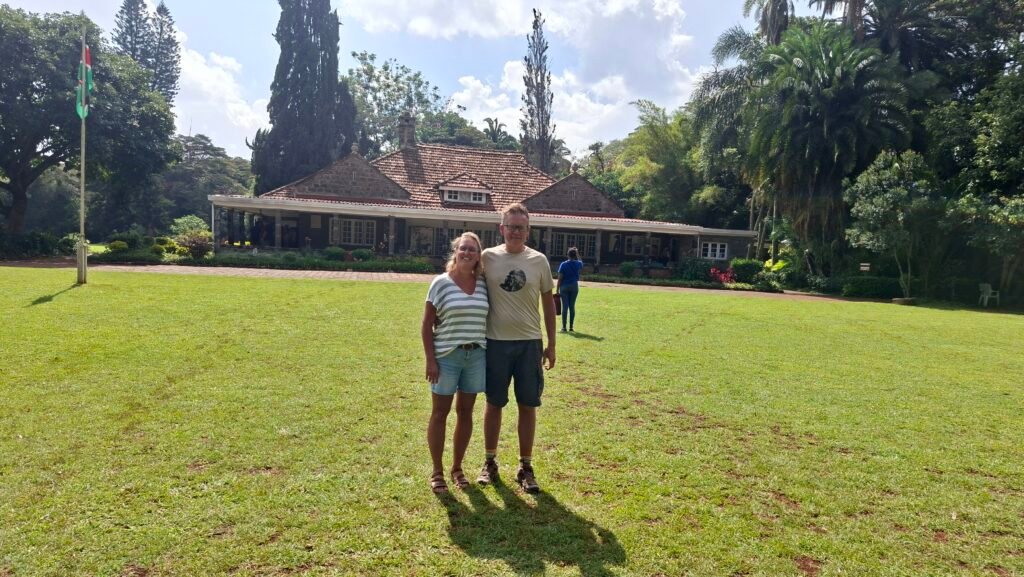
The Grave of Denys Finch Hatton: A Disappointing Visit
On the way to our next campsite, we make a detour to the grave of Denys Finch Hatton, known from Out of Africa. We wait a while for someone to unlock the gate to the garden. A woman arrives and explains she’s the great-granddaughter of Karen Blixen’s cook, sharing some background before telling us there’s a fee to enter the garden and see the grave. We knew there’d be a charge, but when she names the amount nearly €6 per person just to look at a grave we’re taken aback. We offer half, which she refuses, so we decide to skip the grave and leave. She thanks us for wasting her time. 😆
Toward Maasai Land and the Tanzania Border
We continue toward the Tanzania border and find a nice campsite at a resort. The price is on the high side, but the facilities are good until we learn we’re not allowed to cook ourselves, and eating means eating at their restaurant, which quickly gets expensive. So we go looking for another campsite instead.
We head further south, stopping in Kajiado for chicken shawarma, sitting outside as more and more Maasai people pass by. While eating, we search iOverlander for a campsite and find an eco-camp deep in nature. What a sense of calm, and how good it feels to be back in nature. That evening we hear hyenas. We decide to stay longer, and for the first time in a week, we sleep wonderfully. In the evening we enjoy tea by the campfire.
After three days we set off again, this time toward the border crossing with Tanzania. Along the way we see more and more Maasai people we’re clearly in Maasai land now. After an hour and a half, we reach the border.
Overlanding Kenya: Our Conclusion
Our journey through Kenya has come to an end. Looking back, it isn’t our favorite country. Without the big parks, there’s less here than we expected. Lake Turkana looked incredible, but we skipped it over safety concerns. We did have a great time, but the landscapes weren’t quite as striking as we’d imagined, and we found people somewhat less approachable. You can tell they’re used to tourists maybe even a little tourist-fatigued. A lot revolves around money, often quite a lot of it. So far, these are the most reserved people we’ve met in Africa.
Overlanding Kenya wasn’t love at first sight for us but it was still an insightful and adventurous chapter on our journey toward Tanzania.