![logo[26]](https://cruisnnomads.com/wp-content/uploads/2026/02/logo26-120x79.png)
![logo[26]](https://cruisnnomads.com/wp-content/uploads/2026/02/logo26-300x198.png "logo[26]")
Overlanding Tanzania: From the Zambian Border to Lake Tanganyika
This leg of our overland journey through Africa takes us from the Zambia–Tanzania border, via Sumbawanga and Katavi National Park, to Kigoma on Lake Tanganyika a route of roughly 1,280 km that took us 13 days to drive.
Overlanding Tanzania starts, for us, at the border crossing from Zambia, and it starts surprisingly smoothly. Getting out of Zambia takes ten minutes, and immigration on the Tanzanian side moves fast too, helped by the fact that we’d already applied for our visas in advance. But as so often in Africa, the real story only begins at customs.
What’s it like crossing the border from Zambia into Tanzania?
At customs, an official asks us for 25 dollars, without making clear what it’s for. He looks over our Carnet de Passage and fills in some forms. Then comes the request for the 25 dollars. We go back and forth, until someone sends us to a small booth across the road. The official in charge is asleep in there.
We’re told we can pay the 25 dollars in this booth. When he wakes up, we’re told that paying in dollars isn’t possible odd, since the amount was quoted in dollars in the first place. The official walks back with us to customs and explains that we want to pay in dollars, but that this “can’t” be done.
When someone suggests just handing over one dollar to “solve” it, we know for certain something isn’t right here. We don’t want any part of that, and in the end we pay the full amount in dollars, directly at customs. A staff member stamps our Carnet and waves us through. The whole process at customs cost us almost two hours.
Welcome to Tanzania.
First impressions of Tanzania: hills, farmland, and encounters
We set our clocks forward an hour and keep driving. The landscape surprises us right away. Rolling hills slowly give way to flat farmland. On the way to Sumbawanga, a trading town in southwestern Tanzania, we run into another traveling couple we know from Instagram: DNonthemove. A quick chat turns into a small village gathering, with curious looks and laughing faces all around us.
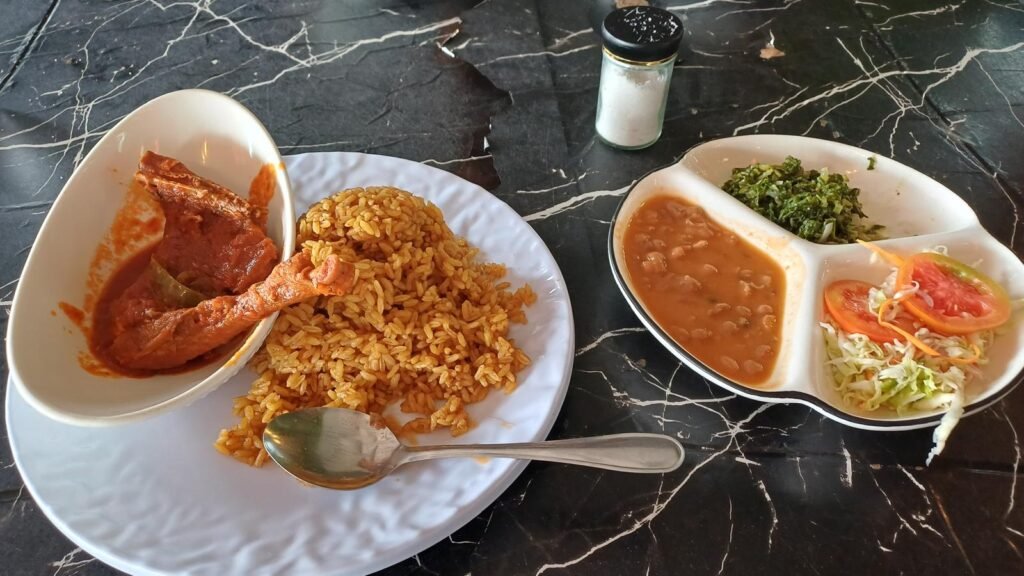
In Sumbawanga we sort out practical matters withdrawing cash, buying SIM cards. We eat rice with chicken and vegetables at a local restaurant. With a coke on the side, the bill comes to under eight euros. We also fill up, because on the road you fuel up whenever you can. Diesel here costs €1.06 per liter, a touch cheaper than in Zambia a small win.
Wild camping near Katavi National Park
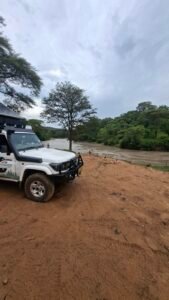
We spend our first night in Tanzania wild camping. The next day we continue along the transit road through Katavi National Park. This remote park in western Tanzania is known for its dense hippo population. Along the way we spot elephants and even a giraffe. Our campsite for the night sits near a new bridge the old one washed away last year. It half looks like a construction site, but one with hippos in the river.
In the evening we listen to hippos, birdsong, and even a distant hyena. These are the moments we travel for.
tanzaniaparks.go.tz/parks/katavi
https://tanzaniaparks.go.tz/parks/katavi
On the road to Kigoma: village life and Nkondwe Falls
In a village along the way we pick up simple supplies: tomatoes, potatoes, onions, and bananas. Three euros gets us enough food for a week. We also have lunch here rice, beans in sauce, and a bit of meat, for under two euros a person. In the meantime, we apply for the East Africa Tourist Visa for Rwanda, Uganda, and Kenya. Within three days, everything is approved.
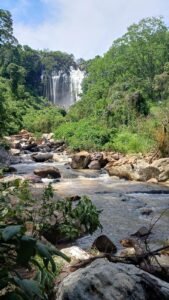
With chapatis for breakfast, we head on toward Kigoma and stop along the way at Nkondwe Falls. We open the gate ourselves, since no one’s around, and walk up to the falls. It’s a beautiful spot, and we sit for a while just taking it in. Then it turns out there is a staff member after all. He waves us along to the top of the falls. While we’re climbing and scrambling over rocks, he strolls ahead effortlessly in flip-flops. The view from the top is stunning. On the way down, Miranda slips luckily, no harm done.
Toward Kigoma and Lake Tanganyika
Later that day we eat at simple roadside food stalls chips and chicken. We find a quiet wild camping spot overlooking a valley and enjoy the silence with a cup of tea.
The next day we drive through forested terrain toward Kigoma. Trucks and buses leave little room on the road, keeping us on high alert. Just before reaching the city, a heavy thunderstorm breaks loose.
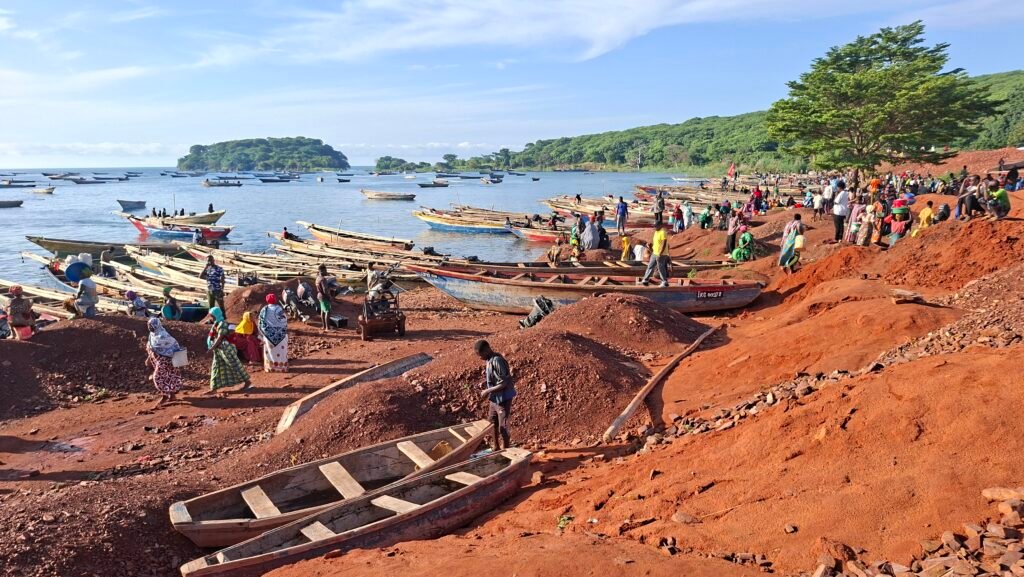
In Kigoma we eat local food again, run a few errands, and then drive on to Jakobsen Beach Camp, on the shores of Lake Tanganyika one of the deepest lakes in the world and the border between Tanzania and the Democratic Republic of Congo. We’re welcomed warmly and settle in for a relaxed evening by the lake.
100 days on the road
While we’re staying here, it suddenly hits us: we’ve now been on the road for 100 days. It feels like we only just left. After a rainy morning, we head into Kigoma for lunch, pick up our laundry, and take a walk overlooking Lake Tanganyika. Then we set course for the Rwandan border.
The last kilometers through Tanzania
Along the way we stop at a restaurant, but leave with a sour taste after an unusually high bill. That night we sleep at a truck stop. Roadworks send us onto a bone-dry sand track, and we end up in thick clouds of dust. We close the windows too late, and the inside of the car turns red with dust. It’s a restless night, with traffic roaring past.
The next morning, it takes us just an hour and a half to reach the Rwandan border.
Tanzania is behind us now. A country of contrasts: bureaucracy and hospitality, rugged wilderness and village life, dusty roads and breathtaking lakes. A chapter we won’t forget anytime soon.
.